A better way to think about the path is simple: start with the job family, then choose the certificate that teaches the tools behind that work.
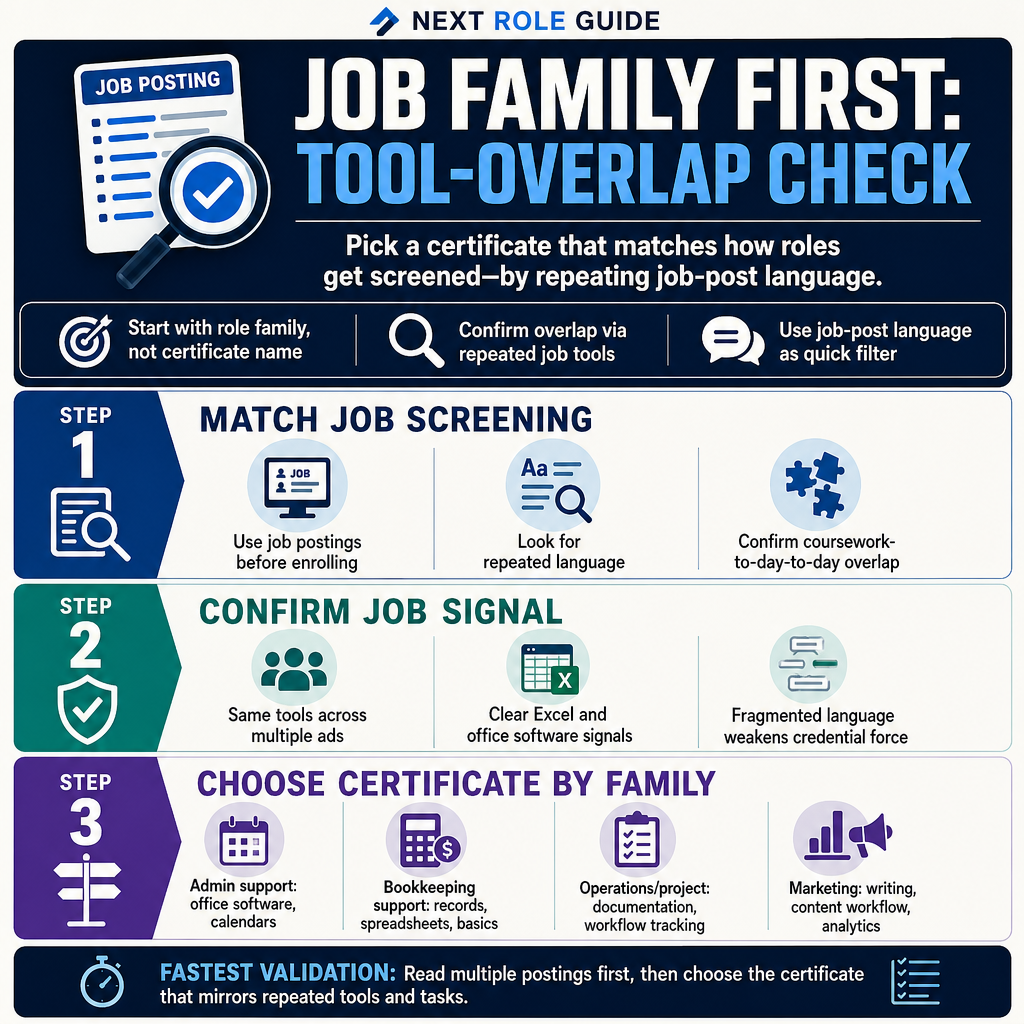
Use the same lens on your own search. If the roles you want repeatedly mention Excel, scheduling, payroll, records, CRM tools, bookkeeping, or office software, a focused business certificate can help you speak the same language as the posting.
The jobs that usually line up with a business certificate
Not every business certificate points to the same career path. Some programs lean toward office work, some toward numbers, and some toward support roles that sit between teams. That is why the job family matters more than the certificate label.
| Certificate focus | Jobs it maps to | Skills that matter most | Best for | Common limitation |
|---|---|---|---|---|
| Office administration | Administrative assistant, office coordinator, receptionist, scheduling support | Calendar control, documents, data entry, communication | People who want a broad entry point into office work | Can feel too general if the coursework stays theoretical |
| Bookkeeping and accounting support | Bookkeeping assistant, AP or AR clerk, payroll assistant | Records, spreadsheets, accuracy, basic accounting language | People who like detail and repeatable tasks | Narrower hiring lane than general admin |
| Operations and project coordination | Operations assistant, project coordinator, workflow support | Task tracking, documentation, handoffs, follow-through | People who like process and coordination | Many employers still want proof of experience |
| Marketing and business communication | Marketing assistant, content support, sales support | Writing, content workflow, basic analytics | People who can organize content and communicate clearly | Portfolio work often matters |
| Customer and sales operations | Customer operations, CRM coordination, sales support | CRM tools, reporting, communication, admin follow-up | People who like service plus systems | Job titles vary a lot by employer |
The strongest certificate is the one that points at a real set of duties. A general business program can still help, but it helps most when the coursework lines up with one of these lanes instead of trying to cover everything at once. If project coordination is your lane, our comparison of the CAPM and the Google Project Management Certificate covers eligibility, study time and how the two connect.
How to read job ads before you choose a program
A lot of people start with the school brochure and only later look at the jobs. That usually leads to a vague credential and a vague search. It works better in the opposite order.
Start by collecting 10 to 15 job postings for roles you would actually accept. Read them for repeated duties and repeated tools, not just job titles. The title may change from one employer to another, but the work underneath often repeats.
Here is the fast filter:
- Write down the tasks that appear again and again.
- Circle the software names that show up more than once.
- Match those tasks and tools to the certificate curriculum.
- Prefer programs that include a project, practicum, internship, or capstone.
- Give extra weight to programs that help you translate coursework into a resume and interview story.
If a certificate spends most of its time on broad business theory, it may be fine as education, but it is weaker as job prep. A hiring manager for office, bookkeeping, or operations support wants to see proof that you can handle the work, not just describe the field.
Who gets the most value from this path
A business certificate is most useful when you need a faster bridge into a practical role. That includes people who are starting from zero, coming back after a gap, or trying to move from one kind of work into another without spending years in school.
This path tends to help most if you are:
- Looking for a first office job
- Moving from retail, service, or unrelated work into admin or operations
- Trying to move up inside a company where the tools and workflow already matter
- Working around a fixed schedule and need an online or evening format
- Trying to build a cleaner resume story around a specific type of work
The value is not prestige. The value is translation. A good certificate helps an employer see how your training connects to the actual job.
When another path makes more sense
A business certificate is not the best fit for every business-related role. Some jobs care more about analysis, strategy, a portfolio, or prior experience than they do about a short credential.
Skip the certificate-alone path when you are aiming for:
- Analyst roles that screen heavily for a degree
- Marketing roles that expect a portfolio first
- Management tracks that want years of experience
- Licensed or regulated work that needs a separate credential
Insurance sales is one example: agents need a state license, with separate licenses for life and health and for property and casualty, as our insurance license guide explains.
That does not mean the certificate is useless in those paths. It means the certificate should support a bigger plan instead of carrying the whole plan. For example, it can help you enter an admin or support role first, then grow from there.
How to make the certificate matter on a resume
A business certificate pulls more weight when it is easy to connect to the job posting. That means your resume should make the connection visible.
Focus on practical language:
- List the tools you learned in a simple skills section
- Add projects that show scheduling, records, spreadsheets, reporting, or communication work
- Use the same verbs employers use, such as track, organize, coordinate, maintain, or support
- Put the certificate near the top if you are new to the field
- Include internship, volunteer, temp, or part-time work that shows office habits and reliability
If you have very little direct experience, the certificate alone will not do all the work. You still need proof. A class project, a practicum, or a short volunteer assignment can help turn the training into something a hiring manager can picture.
Common mistakes people make before they apply
The biggest mistakes usually happen before enrollment, not after.
- Choosing a certificate because it sounds broad
- Picking the shortest program without looking at the job duties
- Ignoring the software and systems named in postings
- Assuming the certificate replaces experience
- Taking a program that has no practical project or work sample
- Treating every business job as if it uses the same skills
The fix is straightforward: choose the path that lines up with the work you want to do tomorrow, not the broadest label on the brochure.
Beginner roles, tools and what the posting rewards
For a beginner, a business certificate points toward routine, organized work built around common software: office support, administrative roles, bookkeeping help, scheduling, customer service and operations support. Typical tool expectations are Excel, Word and Outlook for office basics and document handling. If a posting asks for typing tests, data accuracy or detailed recordkeeping, precision sits at the center of the role, and office work punishes sloppy data entry, missed dates and careless formatting. If you say you will update a record, send a message or route a request, you need to do it.
For admin roles, build comfort with scheduling, document formatting and polite message handling. Customer service is often easier to enter if you communicate well and stay composed under pressure; you do not need to be outgoing, but you do need to sound professional and keep information moving. A posting that asks for several years of experience is usually above the true beginner range even if the title sounds friendly. Skip this path if you want work outside an office, such as field service, trades or technical repair work.
Practical verdict
A business certificate is a good move when your target jobs are office-based, process-heavy, and easy to explain on paper. It works best for admin support, bookkeeping support, operations support, and some sales or marketing support roles. In those lanes, the certificate can give you a clearer entry point and a more credible resume story.
It is a weaker move when the jobs you want are degree-driven, portfolio-driven, or built around years of experience. In those cases, the certificate can still help, but only as one part of a larger plan.
If you are choosing between several programs, pick the one that teaches the tools used in the roles you want, gives you something concrete to show, and fits the schedule you can actually keep. That is the path that turns a certificate into job-ready progress instead of a general business credential.
Frequently asked questions
What jobs can you get with a business certificate?
Common entry points include administrative assistant, office coordinator, bookkeeping assistant, payroll assistant, operations assistant, and sales support roles. The exact title matters less than the duties underneath it.
Is a business certificate enough to get hired?
It can help you get into the conversation for entry-level support roles, but it is rarely the only thing that matters. Employers also look at your resume, your experience, and whether you can explain your skills clearly.
Is an online business certificate respected?
Yes, if the coursework teaches practical tools and the program has a clear link to the jobs you want. The format matters less than the training and the job match.
Should I choose a certificate or an associate degree?
Choose the certificate when you want a faster route into office, support, or bookkeeping work. Choose the associate degree when you want broader transfer options or a stronger long-term ceiling.
Do employers care which school the certificate comes from?
They usually care more about whether the program lines up with the job than about the school name alone. A strong fit beats a flashy label.
Can I use a business certificate to change careers?
Yes. That is one of its main uses. It can help you move from unrelated work into admin, operations, bookkeeping, or other business support roles where practical skills matter.
What if I already have work experience?
Then the certificate works best as a bridge, not a reset. Experience plus targeted training is often stronger than either one alone, especially for internal promotion or a career shift inside the same field.
See Also
Keep planning your next move with How to Get an Insurance License: Which Line First and What Agents Earn, CAPM vs Google Project Management Certificate for Career Changers, and State Salary Cost Coverage Score Checker.
To compare another path, cost, or salary trade-off, read Sybex CompTIA A+ Study Guide Review: Check the Sixth Edition and Both Exams and Certificates for Remote Work: Check the Actual Role Before Enrolling next.